Total Pageviews

Popular Posts

Sunday, August 23, 2015

Bruce Chatwin on San Francisco and poet Robert Duncan

World's Greatest Travel Writer, Bruce Chatwin: "... San Francisco which is so unlike anything else in the US it doesn't really bear thinking about. It's utterly light-weight and sugary with no sense of purpose or depth. The people are overcome with an incurable frivolity whenever they set foot in it. This doesn't mean that one couldn't live here. In fact I think one could easily, preferably with something equally frivolous to do..." (1972).

...We went one night to the grand San Francisco poet Robert Duncan who is famous with the young for his grandiloquent and skilled outbursts on the Vietnam war. I on the other hand thought him one of the most unpleasant people I have ever met, with a waxen witch-like face, hair tied in a pigtail and a pair of ludicrous white sideburns. He gassed on and on in a flat monotone and it was impossible to decide if the tone was hysterical or dead pan. The house was a creepy-crawly nightmare, and betrayed la moralite des choses, all art nouveau of the worst kind. Bloodless fingers fingering the objects as he spoke, and I suspect that if he weren't fingering art nouveau objects he could just as easily be pressing buttons or ordering napalm, so sinister and obsessed with the demonic alternative he was." Letter to Elizabeth, 1972.


Beautiful Pittsburgh, Safe Amid the Mountains

The Local Lens


As residents of Philadelphia and readers of a community paper within the city, most of what we discuss in these pages is about The City of Brotherly Love. But what about Pennsylvania’s other great city, the city of Pittsburgh? Is life in Pittsburgh better than life in Philadelphia? Is Pittsburgh’s downtown section more pleasing to the eye than Philadelphia’s?
My first glimpse of “the steel city” was from a Greyhound bus at age 18 during a cross country trip to San Francisco. I’d been napping in my seat when the driver announced “Pittsburgh.” I woke with a start and spotted the Golden Triangle, which is the colloquial term for the city’s downtown area. For a second I felt what Brigham Young must have felt when he first laid eyes on the place that would later be called Salt Lake City: This is the place! I wanted to get out and explore, but the bus headed off towards Ohio. I never saw Pittsburgh again.
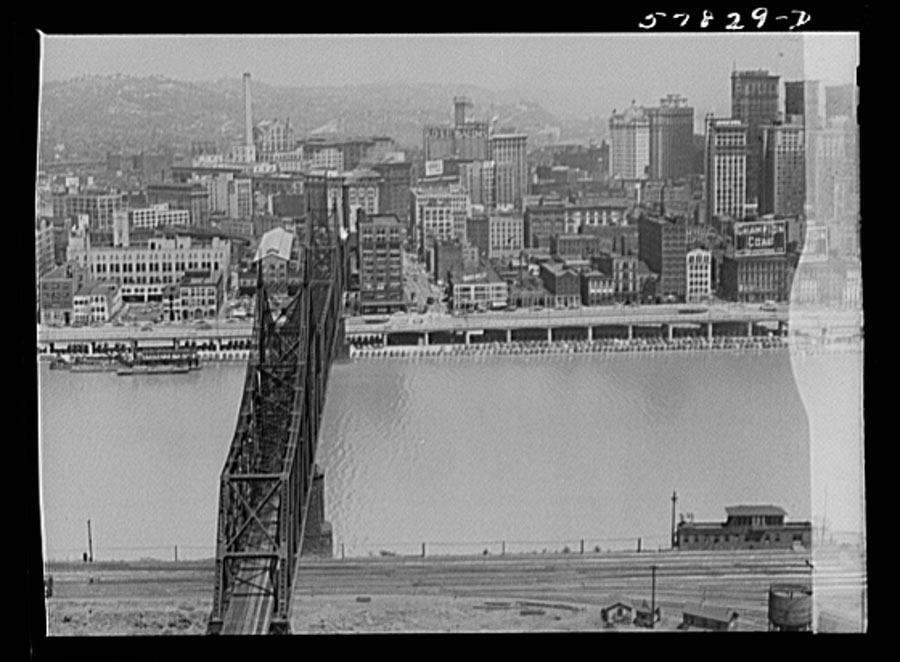
That all changed two weeks ago when I teamed up with friends Tom and Diana, who were headed to Pittsburgh to visit their son and daughter-in-law for a 3-day visit. I didn’t have to think twice when they asked me if I wanted to join them. I packed my bags and before I knew it, we were on the turnpike (with occasional detours on the Lincoln Highway) until at last, Pittsburgh’s skyline came into view. There it was, just as I had remembered it from the Greyhound bus window, only the view was nicer: newer skyscrapers, buildings perched on the tops of the great hills that surround the city. Most spectacular of all were the multiple, multicolored bridges in the middle of the city. So many bridges!
Pittsburgh’s bridges have a fairyland quality to them and they contrast nicely with the houses, buildings and onion domed churches perched on the hills surrounding the downtown area. Philadelphia’s flat topography cannot match this singing, striking landscape.
“Pittsburgh looks great from this angle,” Diana said, “but you wouldn’t want to live here.”
I asked, why not? I was told that Pittsburgh is a very small town where everybody knows everybody — a kind of Mayberry with skyscrapers. Funny, I thought, this is what they say about Philly. Philadelphia isn’t the only city to call itself  “The City of Neighborhoods” because Pittsburgh uses the same tag line.
First impressions of a city are important. At first glance, Pittsburgh seems far less diverse than Philly. Tom and Diana told me that there are more redneck types here than in Philly, although their numbers are diminishing fast as the city becomes more cosmopolitan. Pittsburgh has piqued national notice since the year 2000. Forbes Magazine, for instance, rates Pittsburgh as the nation’s most livable city and even beat out Honolulu, which came in second. The Farmers Insurance Group also voted Pittsburgh as third on a list of ten most secure places to live in the United States. But the real topper is the city’s inclusion in one of the hottest cities of the future lists where it is called, “the next hipster haven.” Philadelphia is also on this list as a city of art (especially murals) and culture.
pittsburgh
Pittsburgh is also ranked among the smartest in the nation. It’s been called a city of bookworms (despite the emphasis on sports). It has the best hospitals in the country and the most affordable housing. Many refer to it as “a hidden gem.”
Our first night on the town gave me a real sense of the city’s smallness in comparison to Philadelphia’s never-ending flat streetscapes. Pittsburgh is a big city in miniature, with miniature crime, miniature graffiti, a highly walkable downtown section and of course, all of those bridges. During my stay, I didn’t spot a single homeless person with a cardboard sign. Perhaps I was in the wrong section of town, because I’m sure Pittsburgh has homeless people, but I couldn’t find any.
Pittsburgh is also a huge sports town –– we’re talking all consuming, reason-to-live, religious-like sports town. Nearly every bar and restaurant in the city has a big screen TV for any game that happens to be on. It doesn’t matter what kind of game, hockey, football, baseball or tennis, as long as it’s sports. Both Tom and Diana hate sports, and I can’t say I am a fan either.
When we visited Three Rivers Park, Pittsburgh’s waterfront area where the Allegheny, Monongahela and Ohio Rivers meet. It was refreshing not to have to cross an I-95 in order to get there. I also liked the way the waterfront piers meet the water as opposed to the elevated piers at Penn’s Landing.
The town has a 1960s time warp quality. As Tom, Diana and I watched the motorboats come and go along the piers, Tom reminded me that Pittsburgh isn’t really a Northeastern city at all but primarily a Midwestern city, then an Appalachian city and only lastly somewhat of a Northeastern city.
The Midwestern flavor of the town is probably why artist Andy Warhol left Pittsburgh on a Greyhound bus after his graduation from Carnegie Mellon. He needed a monolithic, bad-ass city like New York, and he found it. After his death in 1987, his home town honored him with the Andy Warhol Museum and even a small bridge named the Andy Warhol Bridge. The Warhol Bridge is just down the street from the Andy Warhol Museum.
People either love or hate Andy Warhol but in the museum there is only love. I saw large families with little children, teenagers, elderly folks on walkers or canes, inspecting the Campbell’s soup can prints, the Liz, Marilyn and Elvis portraits, and the dicey Joe Dallesandro film stills and the Rolling Stones Sticky Fingers album covers. . The museum houses the complete set of Warhol’s 160 time capsule boxes and many photographs of Warhol’s youth and family, his early paintings and his later films and videos. I think Warhol would have approved of the museum staff. Most are college students decked out in Warhol t-shirts and while observant and focused, the staffers don’t have that TSA-style, museum security guard harshness that one sometimes encounters in standard art museums
In the Warhol video room, I watched a black and white film that Warhol made of Lee Radziwill, John Jr. and Caroline Kennedy a few years after JFK’s assassination. The movie was made one summer at the family’s private beach at Hyannis Port. We see John Jr. peering into Warhol’s camera, making goofy faces and then doing strange zombie contortions with his eyes. John Jr. is about nine years old and Caroline is eleven or so. In another scene, Warhol’s staff buries John Jr. in the sand up to his neck and then make him a mermaid body from the neck down, even giving him big sand breasts and then arranging seaweed as hair over the lower extremities. John Jr. is on a non stop giggle. At one point he complains that he just washed his hair and can’t get it dirty. Then he announces that he has a head itch. A very slender Lee Radziwill walks along the surf in her barely modest string bikini, her wet pony tail looking oddly chic and very New York.
We ate in a lot of restaurants and found the food and ambiance to our liking. Popular are pubs with the kind of bar food you’d find at Standard Tap in Northern Liberties, only you won’t find breaded smelt — probably the most awful dish in the western hemisphere –– anywhere in these Pittsburgh pubs. Standard Tap, unbelievably, insists that breaded smelt is a their best seller. In Pittsburgh, as in Center City or Fishtown, popular restaurants mean long lines, especially at those places that do not take reservations. At one highly prized French eatery, the lines were so long that patrons lingered outside with drinks or sat at the bar until called. Our wait was so long that the bartender offered us an apology.
“I am so sorry about this,” she said. “I don’t know why these people aren’t moving. They have their checks but they won’t move. They won’t go home.”
The chronic sitters didn’t seem to care that other people had been waiting in line for more than an hour. We humorously suggested that the restaurant print on its menu that customer occupation of a table not exceed two and a half hours. We found that one upscale Korean restaurant in the Squirrel Hill area has this request printed at the bottom of their menu. Please do not allow your dining experience to exceed two and one half hours. Ironically, the service in this Korean restaurant was extremely slow and so we came to see the time limit as a reverse psychology protective device. It’s weird the way the world works sometimes.
Sadly, the food at that most sought after French style pub with the hour wait was only mediocre, while the no-name, walk-in lunchtime pubs we visited provided our best dining experiences.
Back in my home in the City of Brotherly love, I’m still thinking of Pittsburgh’s beautiful multicolored bridges. .


Dell Music Center Tailgaters Trash Historic Strawberry Mansion

The Local Lens


There are seven historic house museums in the City of Philadelphia and each one has a unique history. These houses are the city’s link to its historic past. One of these houses, Historic Strawberry Mansion, was built in 1789 by Judge William Lewis, a lawyer and abolitionist. Then called Summerville, Strawberry Mansion was Lewis’ home along the Schuylkill. For some decades, around the turn of the 20th Century, the mansion was a popular restaurant. It later devolved into a less-prestigious place to eat until the Committee of 1926 restored the mansion and opened it to the public as a house museum in 1930.
Today, the house stands as one of the city’s crown jewels, thanks to a recent $2,000,000 renovation. Tour groups regularly meet there and the house is also rented out for banquets, wedding receptions and the like.
Not far from the mansion is the Dell Music Center, an impressive 5,284 reserved seat outdoor amphitheater, which many say is the best amphitheater in the country. The Dell has experienced its own growth odyssey. In 2007 the concert venue was closed but adequate funding saved the day and led to its rehabilitation and reopening in 2010. Along with the Dell’s 5,000 plus reserved seat capacity, its lawn can also seat 600 concert-goers.
As with every big concert or sports venue, you will also find a large number of tailgaters. There’s nothing wrong with a good tailgate party. Tailgate parties are a big sports tradition, most notably near the stadiums in South Philly. There are many varieties of tailgate parties, including those with fully stocked bars in car trunks where the participants don seersucker suits, white straw hats and bow ties. These are Radnor Hunt and Devon Horse Show tailgating parties. Unfortunately, much of the tailgating that goes on outside the Dell during concerts has become a super-trashy event.
Pretend for a moment that you are part of a wedding party, celebrating on the lawn of historic Strawberry Mansion. It’s an evening wedding and the sun is beginning to set. A little earlier in the evening, you and fellow wedding guests noticed the rows of cars and SUVs parking illegally all over the mansion lawn. You probably guessed that the rogue parked cars have something to do with the music coming from the Dell. Since you have already gotten a little used to the loud music and have all but given up on trying to hear the violin trio that the bride’s father hired for the occasion, you’re okay with the cars. You realize that you have to make some concessions in the big city. Like it or not, in a city, loudspeaker-style, surround-sound music seems to rule.
After a while, you notice the bride’s parents trying to maintain brave, tolerant smiles as more and more cars drive up alongside the mansion’s lawn, parking anywhere they please after leaving huge track marks on the grass. Although there are barricades and yellow tape prohibiting rogue vehicles from entering the mansion’s property, people are getting out of their cars, moving the barricades and cutting the yellow tape so that they can park wherever they please.
You join the bride’s parents and watch as more people drive sloppily over shrubs, sometimes backing into flower beds. The mansion house manager looks at the scene with a growing sense of alarm. He knows that historic Strawberry Mansion, the largest of the historic Fairmount Park houses, has just been through an extensive restoration. This has made the mansion a major tourist spot, but now it is being ruined by bellicose tailgaters.
You are chatting with friends when you see figures moving along the edge of the lawn. One of the figures crouches down in a bathroom position and — you can hardly believe your eyes — defecates on the grass. A moment later, another person follows suit.
“Where are the police?” someone in the wedding party asks. Isn’t running over flowerbeds and removing barricades and defecating in public an offense of some sort?
You try to forget the scene for a moment and head into the house where things are a little quieter. You down a cocktail or two and then talk to someone about the upcoming presidential election. Just how crazy is Donald Trump? How long will the system continue to allow Bernie Sanders to beat out Hillary Clinton? Then you hear a loud thump. No, it is not a Dell drum concert sequel from Chaka Khan, Boney James, Jeff Bradshaw or Monifah. Instead, it is a car-colliding-with-something thump. You go outside and have a look around and see that a car has actually backed into a fire hydrant, upending it and pulling it out of the ground. The wedding party at this point has become a little like a freak show. More tailgaters are piling in; there’s a rush, as if a dam has burst.
The house manager tells a few of the guests that the scene they are witnessing has been a problem at Strawberry Mansion for years, but no matter what they do — write letters, make telephone calls — the mansion’s complaints go unanswered by City of Philadelphia officials. This doesn’t make sense to anybody connected with the mansion; with all of these tailgaters, the Dell is losing parking money. At the same time, the property of the city’s largest historic house is slowly being ruined. The wedding guests then notice that the tailgaters are setting up cook ranges, tents and pieces of outdoor furniture on mansion property. BBQ smoke begins to rise over the tree tops as slabs of meat are piled on the grills. Picnic baskets appear. 
The wedding guests spot another public defecator, but the shock isn’t so great this time –– proving William Burroughs’ observation correct: human beings can get used to anything. Still, the wedding guests wonder why the tailgaters can’t be more discreet. Why not hide behind a tree? Why the blatant show-and-tell? By this time, every wedding guest knows that the tailgaters are not paying Dell customers at all, and of course it bothers them that there are no provisions for bathrooms or garbage collection.
Garbage and trash collection is a major undertaking after concert and sporting events. Compound this with Philadelphia’s chronic litter problem, and you have a Filthadelphia mess. Unfortunately, the Dell, unlike the Mann Music Center and the stadium area after a Phillies game, is not very quick in the area of cleanup. When the Dell concert area is cleaned up, the area around the mansion is ignored. The mansion area clean-up is done by the city almost a week later.
Sadly, the mansion bears the cost of its own groundskeeping making repairs to damages caused by tailgaters. This includes making repairs to damaged infrastructure and planting new grass where the cars have driven. Walk around the mansion lawn after a Dell concert and you’ll see some shocking sights, such as tampons and an occasional diaper in the grass. You’ll also find beer bottles, chicken bones and Styrofoam food containers. On one recent lawn inspection, Strawberry Mansion officials found paper towels and napkins soiled with –– you guessed it –– feces. Happy Labor Day!
Historic Strawberry Mansion is not the only historic house museum affected by these Dell tailgaters. Woodford Mansion, Strawberry’s immediate neighbor, has also experienced similar problems, although there’s been no problem with outdoor water closet activities –– at least not yet.
One mansion official called the situation “lawless” and asked why no police are present to hand out tickets or prohibit illegal parking during concerts. He’s right. If the Dell parking lot is too small and insufficient to handle the huge crowds that make it such a popular concert venue, then why not build a multi-level deck over the present parking lot –– especially if the Dell is making profits? If the construction of a deck is against some obscure city code, then why not grandfather it in, in the same way an unidentified source told me that the Dell was able to do with their illegal digital signage? But that’s another story. Barring this, how about just hiring parking regulators?
The most important question is why the city is not listening to Strawberry Mansion when it requests help to remedy the situation? This is not a complaint against loud music. It is also not a war of musical tastes posing as a litter and property destruction problem. Everybody knows that the Dell’s great amphitheater and its musical programs are a good thing for the city. The very least that the city can do is to install “no parking” and tow signs on Strawberry Mansion’s property
Historic Strawberry Mansion has already petitioned the city to make these changes, but the question remains: Will the city listen this time? How long will it take before the changes are made? Will Susan Slawson, First Deputy Commissioner of Recreation and Programs, help make these needed changes?
Let’s hope that the city will come to its senses and help out this crown jewel of house museums. 


Friday, August 14, 2015


Release date November 16, 2015

ICON City Beat August 2015

                                                    ICON Magazine City Beat August 2015


   A visit by the Queen of England or an after death visitation by John Lennon would not rival the September visit of Pope Francis. SEPTA’s railway, bus and trolley routes will be altered, and Mayor Nutter has warned Philadelphians to “be prepared to walk long distances.” This might be a good time to get out of town. The prospect of 1.5 million visitors crammed behind a partial fence in Center City and the Parkway has nightmare potential. Francis is not a pope of “fences” and radical public transportation cutbacks that would mostly affect the poor.  He’s a “let’s rein the people in” pope, not a “shut’em out” ruler. Proof of this is his willingness to criticize the capitalist system of western democracies and point a not so subtle finger at the Koch Brothers, Goldman and Sachs and all the powerful financial brokers and institutions that only want to fatten the pockets of the very rich.  So: Tear down this wall, Mr. Nutter.  
   
 When we went to the premier of Magic Mike XXL at the Prince Theater we noticed a lineup of ushers and glum-looking men in suits. The suits were arranged widthwise across the floor like a chorus line of border guards. We’ve never seen a lineup of suited security at The Ritz, and we’ve certainly never had a pre-movie pat down and a “head to toe” sweep with a counter-terrorism radar brush. Were they checking for weapons, bombs or tubes of nitroglycerin? The suits went about their job with the unfeeling precision of TSA agents. Additional security lined many of the aisles inside the auditorium. During the movie (about a tribe of overbuilt beefy male strippers who talk like Rocky Balboa), a suit aimed a flashlight over a certain segment of the audience. Was something amiss? Did they find that nitroglycerin, or was he checking on potential cell phone violators filming the Warner Brothers production with an iPhone? Do audiences of mainly well behaved young women really need this kind of security?  What has happened to the venerable Prince? Has it turned into a frog? Or has it, unbeknownst to us, merged with Philadelphia International Airport?
 The Plastic Club is a Paris salon in the heart of Philadelphia.  Founded in 1897 as an all woman’s arts club (men were admitted in 1991), early club members included Violet Oakley, Cecilia Beaux and Elizabeth Shippen Green. The word ‘plastic’ refers not to that infamous line in The Graduate, but to unfinished art, though all the pieces on the wall at PC’s July The Models as Artists Show seemed complete to us. The marathon event transformed a dull Sunday into a four hour art and fantasy fest complete with belly, fan and hoola hoop dancing plus a poetry reading that touched on the meaning of Father’s Day. In this age of minimalist art events where less is considered more (“Care for a pretzel stick with that thimbleful of chardonnay?”), the Plastic Club stands shoulders above its (often) less than generous competitors. Some of the winners in the Models Show were: First Prize, Jenn Warpole; Second, Veronica Meekins; Third, Maria Singer, and Honorable Mentions Rachel Glidden, Nellie Carnes and Anna Romaniuk. On Sunday, August 23, PC will host its Annual Summer Dinner; check out the Website at http://www.plasticclub.org/ 
We never understood the attraction of Philly Jesus even when he was everyone’s favorite darling. When Philly Jesus said he used to love gays but now he’s not so sure, we were not surprised. Heroin addicts, ex or current, are often opportunists and go whichever way the wind blows. When Mayor Nutter posed with Philly Jesus for the local paparazzi we saw this as a further dumbing down of Warhol’s fifteen minutes (of fame) to single digits. It irked us that so many media types gave Philly Jesus publicity, either by snapping his picture or by including him in interviews.  Philly Jesus is proof, as if we needed any, that commercial media will suck the udders of any fly- by- night oddity deemed hot by inept culture vultures.
 We went to 920 Clinton Street where writer Agnes Repplier wrote many of her books and had teas for world famous visitors but we were disappointed to see that there was no historic marker near the property. Lesser known lights in the world of jazz and sports get historic markers, but not “the Jane Austen of the essay” who was once esteemed by Edith Wharton, Dorothy Parker and Willa Cather. Is this yet another case of Philly refusing to honor one of its own?    


Tuesday, July 14, 2015

The new American (and international) family

THE LOCAL LENS   

BY THOM NICKELS

  When I worked in a Chester County hospital in the late 1970s I was sitting with several surgeons in the break room when I heard muffled grunts of disapproval. The bone of contention seemed to be the front page stories in both The Philadelphia Inquirer and The New York Times.  The stories concerned a massive Gay Rights march down New York’s Sixth Avenue. Most in that small break room read the newspapers without comment, but one urologist shook his head contemptuously and said, “These protests are a fad, a phase!”

  I heard the words “phase” and told the urologist, “This is not a fad but the beginning of something really big.”  

  One of my favorite anesthesiologist’s happened to be standing in the doorway. She was a tall gangly woman from New Zealand with enormous owl-like glasses. Although well read and generally smart, she had one failing: she loved using the word ‘queer’ when referring to gay men. She proceeded to tell the assembly a story about a “queer” she had once known in New Zealand. “This queer,” she said, “dressed in white, drove a white car and lived in a white house.” 

 Was I missing something here? Then it hit me that she was making a vague reference to bodily fluids. How gross, I thought. She then reminded everyone that playwright Tennessee Williams also wore white. The break room had suddenly become surreal though I couldn’t bring myself to dislike her because I knew that she was just saying these things for group approval since most of the staff considered her an odd duck. She may in fact have been gay herself and just wanted to deflect attention away from her single status.  Homophobic men do this a lot.
    
   The idea of gay marriage in the 1970s was so remote you couldn’t even find references to it in published (gay) science fiction. In early gay liberation circles, men who had long term partners were regarded with suspicion if they said that they were monogamous. The 1970s politically correct way of thinking for activists was to equate romantic jealousy and monogamous long term relationships with wanting to “own” and possess a partner. Wanting to “own” someone body and soul was seen as one of the negative effects of growing up in a patriarchal, capitalist society. Many activists criticized heterosexual marriage as the spawn of capitalism with its idea of spousal “ownership.”  
   
    Homophobia was everywhere in those days. Even in countercultural Boston and Cambridge I used to hear bearded, socialist hippie revolutionaries spout the word ‘fag’ with abandon. They could talk about tearing down the capitol building, but they couldn’t free themselves from a prejudice inherited from their parents and grandparents.   
   
    When the idea of gay marriage first made small strides in the early 1980s, it was a fringe idea at best. Most self respecting gay people valued their personal sexual freedom and saw the insular married world of Ozzie and Harriet as a form of relationship slavery. For many the idea that you could only have sex with one person for the rest of your life seemed like a special kind of hell. But like the acceleration of a small faucet drip into a robust, gushing stream, the idea of gay marriage began to catch on.  The first reports of marriages came from gay-identified churches like the Metropolitan Community Church, or the gay friendly Unitarian Church and the United Church of Christ. In the Jewish world, you’d hear stories of a liberal rabbi uniting two men or two women in a home ceremony.  Reports of renegade Catholic or Anglican priests “marrying” two men or two women would surface a little later, but they were not common.  Generally, these union ceremonies were still regarded as freak occurrences in a community that still saw marriage as a straight institution. “We don’t want to be like straight people,” was a common refrain then.  

       In the early days, MCC couples who wished to tie the knot had a Holy Union ceremony. There were no legal ramifications to this ceremonial blessing. I attended one Holy Union service in the mid 1980s when a Navy lieutenant “married” his sailor boyfriend in the Joseph Priestly chapel at Center City’s First Unitarian Church. The reception was a snapshot of the traditional straight wedding: a sit down meal, champagne toasts, dancing, two men in tuxedos, a tall white wedding cake topped with two grooms plus an end show where the two grooms rubbed cake in each other’s faces. Attending this Navy wedding made me realize that the old activist line concerning marriage was fading, even though the MCC minister at that time was warning male couples who wanted a Holy Union that they first needed to take a serious look into making room “for the occasional other,” meaning, of course, an “on call” boyfriend once the marriage got stale. The assumed truth here was that all marriages, like seltzer water, go flat and that sexual passion eventually dims and fades.

    Now that the Supreme Court has put gay marriage on an equal footing with straight marriage, effectively relegating that those old PC “marriage is bad” activists to the dinosaur bin, the reactions have poured in.  Some people were indifferent to the ruling, claiming that it came too late, way after Canada and most of the western world. Many were jubilant. The ‘thumbs down’ reaction from Vladimir Putin and Russia was expected; ditto for places like Nigeria. Most gays expressed happiness at the Court’s decision despite the fact that many said they would never get married. As one friend of mind commented, “I won’t marry because I’ve made too many romantic mistakes in the past, but I’m glad it’s there as a civil right for others.”

    Of course, making a mistake in marriage can come close to becoming a fatal, if not expensive, error. Two men in their twenties and crazy in love are no different than a boy and a girl of the same age, also crazy in love, or lust, getting the two confused while on a deep chemistry level they are totally incompatible. In the old days the gay guys could split up by walking away from one another. ‘Divorce’ was as easy as slamming a door and going into the nearest gay bar for a fresh meet up, while the poor straight couple went through the prolonged, expensive agonies of legal divorce, complete with high voltage acrimony and vindictive, child visitation debates, alimony payments, not to mention dire end scenarios like, “She took my house, my car, everything,” etc. Yes, falling in love can be dangerous. It can also empty your bank account. 
    
       Some religious zealots responded to the Court’s decision by stating that gay marriages aren’t real anyway while others warned that now marriages will be legalized between humans and pit bulls, brother and sister, mothers and sons. Next up would be the legalization of pedophilia. On Facebook the volatile reactions to the Supreme Court ruling covered every conceivable opinion. The reaction among the haters was relentless and obsessive. One “I hardly know you” FB friend, an older woman, famous for her innocuous FB postings of drippy sweet Hallmark card verses, went Jekyll and Hyde and began dishing out the word sodomite. The transformation of this sweet Church Lady into an angry ‘Exorcist’ Linda Blair type was truly amazing.  Conversely, gay FB friends were also going ballistic, threatening to unfriend anyone who used the slightest homophobic slur. Extreme gay ideologues used the hate expressed against them by fanatical religious groups as a reason to hate back, calling for an end to Christianity or by saying that all Christians are evil.  

   Then, of course, there was the FB post of Father James Martin, from the Jesuit magazine, America, whose FB post reminding Catholics that no matter what their views on the subject, they should be mindful of what the Catholic catechism teaches when it comes to the subject of gay people. In other words, you can be against gay marriage and still be respectful. You don’t have to hate.

    “Catholics who disagree with the Supreme Court must treat gays with respect,” Fr. Martin said, “and with compassion and sensitivity, as the Catechism asks.” Unfortunately, many people did not listen to him, which then forced Fr. Martin to say, “Even after 25 years as a Jesuit, the level of hatred around homosexuality is nearly unbelievable to me.”

    The future looks bright, however, because as the “enlightened” realize, the collective trend is away from bigotry and darkness and into a much more generous, loving and accepting space.   


Friday, July 3, 2015

Coast to Coast AM, with Connie Willis, July, 1 am EST


Coast to Coast AM, where Malachi Martin was Art Bell's guest in the 1990s.


Remote Viewing Feats


Hosted by Connie Willis    
Guest(s): Joe McMoneagleThom Nickels
Host Connie Willis (email) will be joined by Joseph McMoneagle, known as the best Operational Remote Viewer in the history of the U.S. Army's Special Project-- Stargate. He'll describe how he achieves his results using scientifically designed and double-blind protocols, and how he's continued to demonstrate these abilities on camera, and in the lab at the famed Monroe Institute. First hour guest, Philadelphia author, Thom Nickels (Amazon page), shares weird stories of the founding fathers of the US, including the secret life of Ben Franklin.
6-10pm PT: Art Bell - Somewhere in Time returns to 9/30/96 for an evening of Open Lines covering such varied topics as the presidential race, Neanderthals, New Orleans, ValueJet airlines, and the inside of the Sphinx.